Supervisor, District 2: Stephen Sherrill
 Back to supervisor map
 Back to supervisor map
Stephen Sherrill
District 2 Supervisor
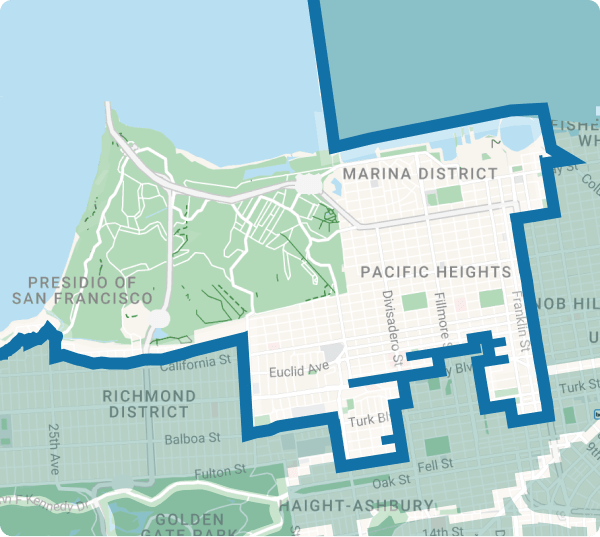
District 2 includes the Marina, Cow Hollow, Pacific Heights, Presidio Heights, Jordan Park, Laurel Heights, Presidio, Lower Pacific Heights, Cathedral Hill, and part of Russian Hill.
Appointed
December 2024
Up for Re-Election
June 2026


Stephen Sherrill was appointed by former Mayor London Breed on December 18, 2024, taking the seat vacated when Catherine Stefani was elected to the California State Assembly. Before joining the Board, Sherrill served as a senior policy advisor in the Bloomberg administration in New York City, then moved to San Francisco where he led the Mayor's Office of Innovation from 2022 until his appointment. He lives in Presidio Heights with his wife and children.
Former Supervisors:
Sign up for GrowSF's weekly roundup of important SF news!
Policy positions & priorities
Safe and Clean Streets
Sherrill has stated that his primary priority is "safe and clean streets" for both District 2 residents and all San Franciscans. He supports fully staffing the police department, reducing unnecessary officer paperwork, and equipping officers with tools such as automated license plate readers, speed cameras, and resources to improve burglary clearance rates. Sherrill is also a strong advocate for ambassador programs and has praised organizations like Urban Alchemy for their contributions to safer streets.
Small Business Support
Sherrill is committed to helping San Francisco's restaurants, bars, and neighborhood businesses recover and thrive. He has introduced multiple pieces of legislation cutting red tape that blocks businesses from opening or expanding — from lifting the formula retail ban on blighted commercial corridors, to creating entertainment zones, to simplifying alcohol permitting for neighborhood theaters. He also acknowledges the challenges local businesses face due to outdated regulations, such as the pre-Prop M policy that charged businesses additional fees for every cash register installed.
Affordability
Stephen is committed to addressing San Francisco's affordability challenges, which he identifies as a critical issue for families and local businesses. His approach emphasizes gradual, data-driven changes to policies that impact affordability, ensuring they are effective and sustainable. He believes in proposing policies, evaluating their impact, and refining them as necessary.
He highlights four interlocking pillars of affordability for families: housing costs, quality public education, reliable and safe public transit, and accessible childcare. He has been vocal about making the city affordable for families by expanding the childcare subsidy to middle-class households and by fixing zoning rules that ban daycares in many parts of the city. He is also exploring a childcare subsidy for downtown workers regardless of residency, to help bring workers back to the city's economic core.
Housing
Stephen supports streamlining building approvals, reducing CEQA friction for moderate-density developments, and capping discretionary appeals. He voted in favor of Mayor Lurie's Family Zoning Plan, which passed the Board 7–4 in December 2025 and creates zoning capacity for roughly 36,000 new unitss. Sherrill supported the plan as a way to satisfy the state's mandate for 82,000 new units while retaining local control over design and density standards. As he explained: "It's just about adjusting the focus to ensure that development goes in the right places in the most neighborhood way possible, but also sticks to the fact that we have a significant state obligation to meet." He also co-introduced an amendment alongside Supervisor Sauter to incentivize the creation of more 2– and 3-bedroom units to better support families.
Sherrill has nonetheless drawn a distinction between planned, neighborhood-appropriate density and what he views as opportunistic overreach. When a developer filed plans in December 2025 to build a 25-story, ~800-unit tower on the Marina Safeway site — leveraging state density bonus laws to exceed local height limits before the Family Zoning Plan took effect — Sherrill opposed the project strongly, calling it "cartoonish," "outrageous," and "a publicity stunt." He said: "Our neighborhoods deserve stability and real rules — not to be blindsided by cartoonish mega-projects trying to exploit loopholes in state law." Sherrill had previously submitted an amendment during the Family Zoning process to shift height allocations away from the Safeway site, and the project remains contested as of early 2026.
Recovery and Treatment
Supervisor Sherrill supported the Recovery First ordinance, introduced by Supervisor Dorsey and signed by Mayor Lurie in May 2025, which establishes long-term remission as the city's primary goal for drug policy. Sherrill has said that people using drugs in public should be directed into treatment and services, and moved off the sidewalks so that families and businesses are not forced to live with open-air drug use. He also supports expanding involuntary holds for people who do not have the mental capacity to care for themselves, either due to mental illness or substance abuse, with clear medical standards for intervention, judicial oversight, and transparency and accountability to prevent abuse or neglect.
Sherrill praised AB2475, a state bill extending the timeframe for hospitals to create post-release treatment plans from five days to 30 days, calling it "a great start" toward reducing barriers to care. He supports drug screening for welfare recipients and believes the current recovery system lacks sufficient emphasis on reintegrating individuals into the workforce after treatment. While he supports a housing-first approach, he stresses that it must be accompanied by substance-use treatment and job assistance.
Government Accountability
Sherrill runs his office with a focus on measurable outcomes, tracking constituent satisfaction and prioritizing accessibility and follow-through. He has called for performance dashboards, departmental scorecards, and real consequences for missed goals across city departments, and has criticized City Hall for allowing delays and opaque processes to drag on for years.
Addressing the Budget Deficit
Stephen views addressing San Francisco's budget deficit as a multi-year endeavor rather than an opportunity for selective funding cuts based on political preferences. He emphasizes preserving funding for emergency services and economic recovery while advocating for careful evaluation of spending priorities to ensure fiscal responsibility.
Key votes and actions
Safety & Policing
- Led the launch of the Pierce's Pledge Gun Safety Storage Program in September 2025, in partnership with SFPD and nonprofit Pierce's Pledge, allowing residents to store firearms securely at any of the city's 10 police stations for up to one year at no cost. The program was designed to reduce risk of harm during custody disputes and other domestic crises. Sherrill said: "This gives families a safe and practical option when circumstances change, and it is no longer safe to keep a gun at home."
- Supported Supervisor Dorsey's Recovery First ordinance, signed by Mayor Lurie in May 2025, which establishes long-term remission as San Francisco's primary goal for drug policy and addiction-related services.
- Praised AB2475, extending the timeframe for hospitals to create post-release treatment plans from five days to 30 days, calling it "a great start" toward reducing barriers to care.
Small Business Support
- Introduced and co-sponsored (with Supervisor Danny Sauter) legislation in January 2025 to lift the formula retail ban on Van Ness Avenue, where Planning Department surveys found a 53% ground-floor commercial vacancy rate. The ordinance cut an average seven-and-a-half-month permitting process to zero. Enacted April 2025, signed by Mayor Lurie.
- Enacted legislation establishing an entertainment zone on Union Street in Cow Hollow, allowing bars and restaurants to sell to-go cocktails during permitted street events. Sherrill said: "2024 was perhaps the hardest year for restaurants since 2008, and we need to be doing more to help them thrive. Entertainment zones work — we've seen them transform places like Front Street and Thrive City, and now it is Union Street's turn."
- Co-announced with Mayor Lurie the renewal of the First Year Free program, which waives city fees for new businesses in their first year. To date the program has helped over 11,000 local businesses open their doors.
- Voted against Supervisor Connie Chan's legacy business protection ordinance in November 2025, which would have required a new conditional use authorization before any business could lease a storefront previously occupied by a legacy business. The measure also would have shortened eligibility for the Legacy Business Registry from 30 to 15 years. City planners, the Planning Commission, and several small business organizations argued the proposal would increase bureaucratic hurdles and risk more vacant storefronts. Because the Planning Commission had already recommended disapproval, the ordinance needed a two-thirds supermajority to pass; it failed.
- Enacted legislation removing the city's 51% food-revenue requirement that blocked most movie theaters from selling alcohol, and simplifying the process for theaters to offer cultural programming. The legislation was tied to the effort to reopen the historic Clay Theatre in Pacific Heights, which closed in 2020 after 110 years. Sherrill said: "Regardless how much we charge for extra butter, no amount of popcorn is going to make 51% of their revenue."
Housing & Affordability
- Voted in favor of Mayor Lurie's Family Zoning Plan (7–4, December 2025), which creates zoning capacity for ~36,000 new units to meet the state's 82,000-unit mandate. Co-introduced an amendment with Supervisor Sauter to incentivize more 2– and 3-bedroom units to better support families.
- Opposed the proposed 25-story, ~800-unit tower on the Marina Safeway site, filed by developer Align Real Estate using state density bonus laws to exceed local height limits before the Family Zoning Plan took effect. Sherrill called the project "cartoonish," "outrageous," and "a publicity stunt," and had previously submitted a Family Zoning amendment to shift height allocations away from the Safeway site. The project remains contested as of early 2026.
- Co-sponsored legislation extending the sprinkler compliance deadline from 2027 to 2032 for approximately 9,800 residential units in the Marina, Nob Hill, Russian Hill, and Telegraph Hill, where compliance costs had been estimated at $200,000–$300,000 per unit.
Constituent Services
- Negotiated with SFMTA to delay a transition from two-hour free parking to paid parking in District 2, one of his first actions in office, in direct response to community feedback.